
Abstract book of the 18th Conference of the EAVP
Pterosaurs from Coahuila
New elephant cranium from early Pliocene Ileret, Kenya
Les sélaciens du Miocène de la région de Montpellier
Muridae du Pliocène supérieur d'Espagne et du midi de la France.
Contribution à l'étude des genres Gliravus et Microparamys.
Eocene (57) , Quercy Phosphorites (38) , Systematics (32) , Rodents (29) , Mammalia (27) , Rodentia (25) , Miocene (25)
Page 2 of 2, showing 9 record(s) out of 29 total

|
Rongeurs Miocènes dans le Valles-Penedes 2 : Les rongeurs de Castell de BarberaJean-Pierre Aguilar, Jordi Agusti
Published online: 20/04/1979 |
|
|
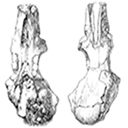
Rongeurs Miocènes dans le valles-Penedes 1 : Les rongeurs de Can Ponsic 1Jean-Louis Hartenberger and Miquel Crusafont i PairóPublished online: 20/04/1979Keywords: Can Ponsic 1; Miocene; Rodents; Valles-Penedes https://doi.org/10.18563/pv.9.1.1-15 Abstract The rodents from the spanish locality of Can Ponsic 1 bring new data about some rodents species of the beginning of the Upper Miocene in South-West Europe. The criticims made by Mein and Freudenthal about the validity of the species Hispanomys thaleri from Can Llobateres are not justiíied. The study of the anatomy of the skull of Rotundomys from Can Ponsic 1 gives accurate information about the affinity of this genus with Cricetulus, and shows that the hypothesis, according to which Rotundomys is an ancestral form of the Arvicolids, is unlikely. The systematics of Heteroxerus and the phylogeny of the mio-pliocene Muscardinus species are also discussed. The Can Ponsic 1 locality is a little older than Can Llobateres. PV article infos Published in Vol. 09, Fasc. 1 (1979) |
|

|
Les rongeurs de l'Oligocène inférieur d'EscampsMonique Vianey-Liaud
Published online: 01/12/1974 |
|

|
The microfauna of the Djebel Qafze CaveG. HaasPublished online: 15/09/1972Keywords: Micromammals; Rodents https://doi.org/10.18563/pv.5.5.261-270 Abstract This study examines the microfauna from Djebel Qafze Cave, focusing on mammalian remains, with Microtus guentheri as the dominant species and a notable absence of Cricetinae (hamsters). The richest layers (XVIa, XVII, XVIII) suggest accumulation by raptors, particularly owls, given the high presence of nocturnal species like voles and shrews. Two significant species, Arvicanthis cf. ectos and the newly described Rattus (? Mastomys) nazarensis, are highlighted. Reptiles (gekkos, Ophisaurus) and birds are also present, while hedgehogs and lagomorphs are absent. The findings underscore the role of avian predators in fossil deposition and refine the chronology of regional Pleistocene fauna. PV article infos Published in Vol. 05, Fasc. 5 (1972) |
|

|
Les Pseudosciuridae (Mammalia, Rodentia) de l'Eocène moyen de Bouxwiller, Egerkingen et Lissieu.Jean-Louis HartenbergerPublished online: 30/10/1969Keywords: Bouxwiller; cranium; Egerkingen; Middle Eocene; Rodents https://doi.org/10.18563/pv.3.2.27-64 Abstract The description of new material from three classic middle Eocene localities of western Europe permits the addition of details to the systematics of primitive Pseudosciurids. The cranial anatomy of Protadelomys cartieri (STEHLIN and SCHAUB) from Egerkingen is described here and compared to that of the Adelomyines from the late Eocene, until now the only ones known. The morphologic and biometric study of the dentition of P. cartieri compared to that of P. alsaticus n. sp. from Bouxwiller and P. Iugdunensis n. sp. from Lissieu, forms respectively older and younger than P. cartieri, permits the evolutionary tendencies of the group to be demonstrated and shows that notable differences in age exist between these localities. This ensemble of forms can constitute a valuable guide lineage in the establishment of a fine stratigraphy of the period. Other less well known lineages are present at Egerkingen along with P. cartieri. They can be related to genera that have been noted int he late Eocene. In conclusion, a criticism of recent zonation proposals, made by divers authors, completes this article. PV article infos Published in Vol. 03, Fasc. 2 (1969) |
|

|
Muridae (Rodentia) du Pliocène supérieur d'Espagne et du midi de la France.Jacques MichauxPublished online: 20/09/1969Keywords: Anthracomys meini; Castillomys crusafonti; Pliocene; Rodents; Valerymys ellenbergeri https://doi.org/10.18563/pv.3.1.1-25 Abstract The murid fauna of the terminal Pliocene of southwest Europe is rich in at least eight genera and ten species. With the species belonging to the genera Apodemus, Rhagapodemus, and Stephanomys not being studied here, the study of the other murids resulted for one thing in the description of three new genera and three new species: Castillomys crusafonti n. g., n. sp., Occitanomys brailloni n. g., n. sp., Anthracomys meini n. sp., Valerymys ellenbergerí (THALER) n. g., and for another thing in the recognition of a form hitherto unknown in this region, Micromys praeminutus KRETZOI. Systematic study has shown that certain species of the terminal Pliocene fauna had their ancestors in the Turolian fauna presently known in Spain. The evolutionary lineages thereby recognized have been studied more in detail and a list of the evolutionary tendencies of the dendal characters has been given. A chart of the probable phyletic relationships between the different murids of the Pliocene faunas of southwest Europe (With the genus Rhagapodemus and Apodemus dominans being excluded) is given in conclusion of this work. PV article infos Published in Vol. 03, Fasc. 1 (1969) |
|

|
Rongeurs de l'Oligocène moyen provenant de nouvelles fouilles dans les phosphorites du QuercyMonique Vianey-Liaud
Published online: 15/09/1969 |
|

|
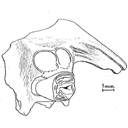
Rongeurs nouveaux de l'Oligocène Moyen d'Espagne.Louis ThalerPublished online: 15/09/1969Keywords: Cricetidae; Oligocene; Pseudocricetodon; Rodents; Theridomys https://doi.org/10.18563/pv.2.5.191-207 Abstract Description of four new rodents from a recently discovered locality at Montalban. Theridomys crusafonti nov. sp. is considered as the ancestry of T. Iembronicus. Theridomys varian: nov. sp. includes «Theridomys» morphotypes and «Blainvilllimys» morphotypes; it could be ancestral to B. blainvillei. Pseudoltinomys nanus nov. sp. represents a new lineage paralleling in evolution that of P. gaillardi (which is equally found at Montalban). Pseudocricetodon montalbanensis nov. gen., nov. sp. designates a lineage of very small Cricetidae accompanying Eucricetodon. With these well defined new species and six others present in the locality, Montalban appears as the best faunal reference point within the biochronologic zone of La Sauvetat. PV article infos Published in Vol. 02, Fasc. 5 (1969) |
|
|
Les Paramyidae (Rodentia) de l'Eocène inférieur du bassin de Paris.Jacques MichauxPublished online: 15/07/1968Keywords: Ailuraviinae; Eocene; Paramyinae; Rodents https://doi.org/10.18563/pv.1.4.135-193 Abstract The exploitation of new early Eocene localities in the Paris Basin has resulted in the collecting of numerous mammalian remains, among which are about 300 isolated teeth representing the rodents. They belong, for the most part, to the paramyid group. Only the latest level of the early Eocene has yielded rodents belonging to the pseudosciurid group. The paramyids, the object of this study, are represented by at least 5 genera and 10 species; they are distributed among 4 clearly dilferentiated subfamilies : Paramyinae Simpson 1945, Pseudoparamyinae Michaux 1964, Ailuraviínae n. subf., Microparamyinae Wood1962. PV article infos Published in Vol. 01, Fasc. 4 (1968) |
|
Page 2 of 2, showing 9 record(s) out of 29 total
