|
Les Ischyrictis de la transition Vindobonien-Vallésien
Published online: 15/09/1972
Keywords:
Ischyrictis; Mustelidae
https://doi.org/10.18563/pv.5.5.253-260
Abstract
Le groupe des Mustélides « Ischyrictoïdes » développe des tendances évolutives qu’engendrent des formes de Carnassiers prédateurs robustes et de grande taille. C’est une évolution comparable à celle que l’on trouve chez Plesiogulo, qui, lui, a une origine énigmatique (Petter, 1963). Chez les Mustélides on peut signaler deux lignées assez nettes : celle du sous-genre nominal des Laphyctis, plus conservatrice, plus mustéliforme, renfermant les espèces Ischyrictis (Laphyctis) mustelinus VIRET et L. zibethoides BLAINVILLE ; celle de type félinoïde caractérisée par L. Ginsburg (1961) avec la forme type Ischyrictis (Hoplicitis) florancei du Vindobonien inférieur de Pontlevoy-Thenay et I. helbingi VIRET, 1951 du Vindobonien supérieur de la Grive Saint-Alban. De plus rappelons que I. vorax DEHM et I. comitans DEHM du Burdigalien de Wintershof-West sont sans rapport avec les espèces du Miocène supérieur (Ginsburg, o.c.).
Récemment G. Petter (o.c.) a montré la difficulté qu’il y avait à envisager que l’Ischyrictis de Can Llobateres qu’elle décrivait puisse être le descendant de Ischyrictis helbingi de La Grive : la forme plus récente est évidemment de plus grande taille, mais le développement très marqué et la position avancée du protocône paraissent constituer un obstacle à une telle filiation.
Donc on signalait jusqu’ici deux lignées de Mustélides « ischyrictoïdes » toutes deux de grande taille : d’une part I. zibethoides de Sansan, d’autre part I. helbingi de la Grive. Or à notre point de vue nous considérons actuellement qu’il existe très probablement trois phyla d’Ischyrictis. Le premier serait représenté par les formes burdigaliennes déjà nommées I. vorax et I. comitans ; il se caractériserait par la perte précoce de la P₁ inférieure et la forme spéciale de la canine inférieure. Ce premier ensemble pourrait être rassemblé dans le sous-genre Laphyctis. Le reste des ischyrictoïdes de type conservateur, pour ce qui est de la région des prémolaires et de la forme de la canine, pourrait être subdivisé en deux sous-genres : le sous-genre Ischyrictis désignant les formes les plus mustéliformes avec I. mustelinus et I. zibethoides d’une part, et le sous-genre Hoplicitis pour les formes félinoïdes avec I. florancei et I. helbingi.
PV article infos
Published in Vol. 05, Fasc. 5 (1972)
|
PDF
|

|
Une nouvelle espèce d'Hipparion du Miocène terminal d'Espagne.
Published online: 31/01/1971
Keywords:
Hipparion; Late Miocene; Spain; Villafranchian
https://doi.org/10.18563/pv.4.2.59-66
Abstract
The recently discovered, very rich, Pliocene locality of Layna (Soria, Spain), has already yielded 30 species of mammals. Hipparion fissurae, described here is more dolichopodic than other Hipparion. It is related to Hipparion crusafonti from Villaroya (Villafranchian), but more slender between other characters.
PV article infos
Published in Vol. 04, Fasc. 2 (1971)
|
PDF
|

|
Les Gliridés (Rodentia) de l'Oligocène supérieur de Saint-Victor-la-Coste (Gard).
Published online: 28/10/1968
Keywords:
Gliridae; Late Oligocene
https://doi.org/10.18563/pv.2.1.1-16
Abstract
The locality of St.-Victor-la-Coste (Gard) has yielded, rather abundantly, teeth of two glirids hitherto very poorly known: Glirudinus praemurinus (Freudenberg) and Glirudinus glirulus (DEHM). It has permitted, moreover, new views on the evolution of Peridyromys murinus (POMEL). Study of these forms confirms the late Oligocene age of the fauna, without allowing, however, further precision.
PV article infos
Published in Vol. 02, Fasc. 1 (1968)
|
PDF
|

|
Palaeotis weigelti restudied : a small middle Eocene Ostrich (Aves : Struthioniformes)
Published online: 20/06/1987
Keywords:
Aves; Central Europe; Middle Eocene; Palaeotis; Struthioniformes
https://doi.org/10.18563/pv.17.2.27-42
Abstract
Palaeotis weigelti, from the Middle Eocene of central Europe, is a flightless, paleognathous bird. It appears to be a member of the ostrich lineage on the basis of trivial derived characters. It is a very primitive ratite, however, and does not possess any of the highly specialized cursorial adaptations that characterize the modern steppe -and savanna- dwelling ostriches.
PV article infos
Published in Vol. 17, Fasc. 2 (1987)
|
PDF
|

|
Contributions à l'étude du gisement Miocène supérieur de Montredon (Hérault). Les grands mammifères. 5 - Les périssodactyles Equidae
Published online: 15/11/1988
Keywords:
Equidae; Hipparion; Late Vallesian; Mammalia; Montredon; Perissodactyla
https://doi.org/10.18563/pv.18.ext.65-96
Abstract
Revision of the hipparion material from Montredon, including newly excavated and other unpublished specimens brings evidence of specific heterogeneity.
A fragmentary very small MC III seems very close to H. macedonicum from the upper Vallesian of Ravin de la Pluie, Greece. In that same site was also found a large hipparion.
Most of the Montredon material is referred to H. depereti. This species associates characters usually found in Vallesian hipparions (highly plicated upper cheek teeth, deep vestíbular grooves on the lower cheek teeth, robust metapodials) with characters more frequent in Turolian forms (middle size, lack of confluence in the upper premolar fossettes, lack of ectostylids on the adult lower cheek teeth, well developped keel on the MC III, facette for the 2nd cuneiform present on all MT III). H. depereti shares some of these characters with the Spanish and Portuguese hipparions transítional between the Vallesian and the Turolian (Masia del Barbo, Azambujeira) but is not identícal to any of them. The upper Vallesian hipparion material from Diavata, Greece, probably belongs to H. depereti but not the large hipparion rests from Ravin de la Pluie.
Thus, Montredon and Ravin de la Pluie may well share the same small species, H. macedonicum, but they differ in the associated one: middle-sized H. depereti at Montredon, large-sized H. primigenium at Ravin de la Pluie. Both sites, however, give evidence of small hipparions during the Vallesian, coexisting with other larger species.
The present paper also proposes an adaptation of the Kiesewalter's indices that calculates the height at the withers using the metapodial length, and discusses indices proposed by Gromova and by Sen et al. to express the relative development of the metapodial keel.
PV article infos
Published in Vol. 18, Ext (1988)
|
PDF
|

|
Un Haplobunodontidae nouveau Hallebune krumbegeli nov.gen. nov.sp. (Artiodactyla, Mammalia) dans l'Eocène moyen du Geiseltal près Halle (Sachsen-Anhalt, Allemagne)
Published online: 14/06/1995
Keywords:
Artiodactyla; Geiseltal; Germany; Mammal; Middle Eocene; new gen.; new sp.
https://doi.org/10.18563/pv.24.1-2.85-99
Abstract
A new genus and species of haplobunodontid artiodactyl, Hallebune krumbiegeli nov. gen. nov. sp., is described from the middle Eocene Geiseltal Fauna (Saxon-Anhalt, Germany). Its stratigraphic range is restricted to the MP 13 ("obere Mittelkohle") of the Geiseltalian. The material consists of seven fragments, representing both upper and lower jaws. It is indicated, that H. krumbiegeli was a small bunodont herbivore. The size and primitive character of the teeth suggest that the genus possibly is directly derived from Diacodexeidae.The new material forms the basis for reinterpreting the haplobunodontid phylogeny.
PV article infos
Published in Vol. 24, Fasc. 1-2 (1995)
|
PDF
|

|
The endocranial cast and encephalization quotient of Ptilodus (Multituberculata, Mammalia)
Published online: 11/02/1993
Keywords:
encephaIization quotient; endocranial cast; Montana; Multituberculata; olfactory bulbs; Paleocene; Ptilodus
https://doi.org/10.18563/pv.22.2-3.99-112
Abstract
Simpson (1937a) reconstructed the brain of the Paleocene multituberculate Ptilodus as having the olfactory bulbs widest anteriorly, an unusual condition among mammals. Slight preparation and reexamination of the endocast specimens of Ptilodus reveals that the olfactory bulbs in fact taper anteriorly, as in the recently-described endocranial casts of three multituberculate species from the Late Cretaceous of Asia, and as in those of other mammals. The brain of Ptilodus was therefore essentially of the same general pattem as in other multituberculates. Ptilodus differs, however, in having the vermis more deeply inserted between the cerebral hemispheres. Other details concerning the endocast morphology of Ptilodus are clarified.
The encephalization quotient (EQ) of Ptilodus is recalculated from revised estimates of both endocranial volume and body mass to fall somewhere within a broad range of values; from 0.41 to 0.62 if the olfactory bulbs are included and from 0.37 to 0.55 if they are not. In any case, the relative brain size of Ptilodus is roughly equivalent to that of Chulsanbaatar, the only other multituberculate for which EQ has been calculated, but considerably smaller than that of an average extant mammnal.
PV article infos
Published in Vol. 22, Fasc. 2-3 (1993)
|
PDF
|

|
Crivadiatherium iliescui n. sp., nouvel Embrithopode (Mammalia) dans le Paléogène ancien de la dépression de Hateg (Roumanie).
Published online: 30/12/1985
Keywords:
Embrithopods; Late Eocene; Paleobiogeography; Romania
https://doi.org/10.18563/pv.15.3.139-157
Abstract
The investigations undertaken at Crivadia (Hateg Depression, Hunedoara District, Romania), the type locality of Crivadiatherium mackennai RADULESCO el al. (Radulesco, Iliesco et lliesco, 1976), led to the discovery of remains of a new Embrithopod. Close to the above mentioned species, but larger in size, this animal is here described as a new species of Crivadiatherium, C. iliescui. ln addition, the comparison made between the forms indicated above and Palaeaamasía kansui OZANSOY from the Eocene deposits of Anatolia (Ozansoy, 1966; Sen et Heintz, 1979) showed that the latter species included a heterogeneous material; this permitted us to distinguish the form in the Anatolian locality Ciçekdag-Arabin Kôyü under the name Palaeoamasia sp. The geographical distribution and diversity of the Embrithopod species under discussion (Balkan, Anatolia) support the idea of an eurasiatic origin of this group and seem to suggest the existence during the Eocene of a particular faunal province in south-eastern Europe.
PV article infos
Published in Vol. 15, Fasc. 3 (1985)
|
PDF
|

|
A new vertebrate locality in the eifelian of the khush-yeilagh formation, Eastern Alborz, Iran
Published online: 01/02/1980
Keywords:
Devonian; Iran; khush-yeilagh formation; Vertebrate
https://doi.org/10.18563/pv.9.5.133-154
Abstract
A new Devonian vertebrste locality has been discovered in 1976 in the basal part of the Khush-Yeilagh Formation in the eastern Alborz Mountains of Iran. The fossils occur in a band one centimeter thick which is identifiable at other outcrops in the area. A preliminary study of the remains has yielded the following faunal list : Placodermata (Phlyctaeniida indet.. Groenlandaspididae indet.. Coccosteidae indet., Holonema sp., Ptyctodontida indet., Antiarcha indet., Bothriolepis cf. kwangtungensis), Elasmobranchii (Ctenacanthidae indet.), Acanthodii (Gyracanthus sp., « Onchus » overathensis, Ischnacanthiforme indet.), Dipnoi (? Dipteridae indet.), « Crossopterygii ›› (Onychodus cf. sigmoides, Holoptychiidae indet., Osteolepididae indet.). This fauna is older than the Middle Givetian and probably of Middle or Lower Eifelian age. Owing to its diversity, it may prove possible to use it in the future as a reference fauna for the study of the Devonian vertebrates in Central Asia and the Middle East.
PV article infos
Published in Vol. 09, Fasc. 5 (1980)
|
PDF
|

|
La poche à phosphate de Ste-Néboule (Lot) et sa faune de vertebres du Ludien superieur. 14 - Conclusions générales
Published online: 25/09/1978
Keywords:
Eocene; Quercy Phosphorites
https://doi.org/10.18563/pv.8.2-4.319-326
Abstract
Le matériel provenant de nouvelles fouilles dans les phosphorites du Quercy, soumis aux divers spécialistes, a conduit à la soutenance de plusieurs thèses d'état: sur les rongeurs (Hartenberger, Vianey-Liaud), les Chiroptères et Insectivores (Sigé), les Artiodactyles (Sudre), les Squamates (Rage) et, en partie, les Chéloniens (De Broin). Chacun dans son domaine, à côté des conclusions d'ordre évolutif, paléogéographique ou paléoécologique, a pu établir des successions stratigraphiques des gisements du Quercy qui se sont révélées largement concordantes. Ainsi la succession des faunes du Quercy est actuellement l'une des mieux établies. Dans ce contexte, les différents spécialistes ont décidé de conjuguer leurs efforts dans l'étude monographique de plusieurs gisements repérés le long de cette échelle, afin de rassembler l'information paléontologique sur des faunes bien précises et de tenter d'obtenir des indications d'ordre taphonomique.
PV article infos
Published in Vol. 08, Fasc. 2-4 (1978)
|
PDF
|

|
Premières données sur les rongeurs de la formation de Ch'orora (Ethiopie) d'âge Miocène supérieur. I: Thryonomyidés
Published online: 01/10/1980
Keywords:
Ethiopia; Paraulacodus; Rodents; Upper Miocene
https://doi.org/10.18563/pv.9.ext.365-374
Abstract
The genus Paraulacodus has been collected in the Ch'orora formation of Upper Miocene age, in Ethiopia. The new species, P. johanesi n. sp.. is more evolved than the previously described indian species P. indicus HINTON of the Siwalik Hills area. The morphological gap between P. johanesi and the present Thryonomys is still important.
PV article infos
Published in Vol. 9, Ext (1980)
|
PDF
|

|
Analysis of mammalian communities from the late Eocene and Oligocene of southern France
Published online: 15/12/1986
Keywords:
Late Eocene; Mammalian communities; Oligocene; Quercy; Southern France
https://doi.org/10.18563/pv.16.4.191-212
Abstract
Valverde's cenogram method is used to analyse mammalian communities from the late Eocene to late Oligocene of southern France, mainly from the "Phosphorites du Quercy". Cenogram analysis involves plotting the size of each component species in a fauna on a semilog diagram in rank order, permitting fossil faunas to be compared with Recent ones. The configurations of Recent communities serve as models for establishing the general environmental characteristics of fossil mammalian faunas. This method of analysis applied to faunal sequence can reveal major and sudden ecological perturbations. The paleobiogeographical event (i.e. the mammalian immigration wave) at the Eocene-Oligocene Boundary in western Europe, known as the «Grande Coupure", is here shown to represent a drastic and sudden ecological change: late Eocene tropical environments in Europe deteriorated rapidly turning to subdesert or desert environments al the beginning of the Oligoccne.
PV article infos
Published in Vol. 16, Fasc. 4 (1986)
|
PDF
|

|
Révision des Rhombodontidae (Neoselachii Batomorphii) des bassins à phosphate du Maroc
Published online: 20/05/1994
Keywords:
Batomorphii; Maastrichtian; Morocco; New taxa; Phosphate; Rbombodontidae
https://doi.org/10.18563/pv.23.1-4.1-49
Abstract
The revision of the Rhombodontidae from the Maastrichtian of Morocco led us to the description of a new species: Rhombodus andriesi.
The biometrical study of populations of R. binkhorsti and R. microdon, species sometimes considered as synonymous, supports the conclusion that they represent two distinct species and not young and adult specimens of a single species. The stratigraphical range of these two species confirms this
result.
The reexarnination of type-series studied by C. Ararnbourg led us to revise the generic status of Rhombodus bondoni which is now ranged, because his dental features, in the new genus Dasyrhombodus showing a less derived dentition than Rhombodus. The stratigraphical range of each species is clarified within the phosphatic series.
PV article infos
Published in Vol. 23, Fasc. 1-4 (1994)
|
PDF
|

|
Artiodactyla from the early Eocene of Kyrgyzstan
Published online: 16/12/1996
Keywords:
Artiodactyla; Asia; Diacodexeidae; Eocene; Kyrgyzstan
https://doi.org/10.18563/pv.25.2-4.359-369
Abstract
Isolated upper cheek teeth of the primitive artiodactyl Diacodexis sp., upper molars of Eolantianius russelli gen. et sp. nov. (Diacodexeidae), two lower molars tentatively referred to Eolantianius russelli gen. et sp. nov., and astragali of Diacodexeidae indet. are described from the early Eocene (late Ypresian) of locality Andarak 2 in Kyrgyzstan.
PV article infos
Published in Vol. 25, Fasc. 2-4 (1996)
|
PDF
|

|
Présence de Palaeobatrachidae (Anura) dans des gisements tertiaires Français caractérisation, distribution et affinités de la famille
Published online: 15/05/1972
Keywords:
Anura; Palaeogeography; Systematics
https://doi.org/10.18563/pv.5.4.157-177
Abstract
The Palaeobatrachidae until now have not been reported from France. The present note makes known the discovery of very significant remains in three Tertiary localities of France: Cernay (late Paleocene), Laugnac (late Aquitanian) and Sansan (middle Helvetian). The osteologic characters, as well as the geographic and stratigraphic distribution of the family are re-stated with added details. The Palaeobatrachidae are a European family known from the late Jurassic of Catalonia (publication in course by J. Seiffert) to the Plio-Pleistocene (pre-Mindel) of Poland and Rumania. By their way of life and certain osteologic characters they are similar to the Pipidae, but they are distinguished by profound differences. It would be rash to include them in the Pipoidea or even in the Aglossa. They are apparently an independant group, essentially holarctic, which held in Europe a role equivalent to that played by the Pipidae south of Tethys.
PV article infos
Published in Vol. 05, Fasc. 4 (1972)
|
PDF
|

|
Mammals and stratigraphy : Geochronology of the continental mammal-bearing Tertiary of south America.
Published online: 15/12/1983
Keywords:
Cenozoic; Geochronology; Mammalia; South America; Stratigraphy; Tertiary
https://doi.org/10.18563/pv.13.ext
Abstract
The principles and practices employed in establishment and recognition of South American land mammal ages are reviewed along with previous and present concepts of distinguishing time, rock, and faunal units. Previous chronological arrangements of South American Tertiary land mammal faunas are appraised on the basis of recent geological and paleontological data. Twelve South American Tertiary land mammal ages are here recognized [from oldest to youngest, Riochican (middle to late Paleocene); Casamayoran (early Eocene); Mustersan (middle Eocene); Divisaderan (late Eocene); Deseadan (early [to middle?] Oligocene); Colhuehuapian (late Oligocene); Santacrucian (early Miocene); Friasan (middle Miocene); Chasicoan (late Miocene); Huayquerian (latest Miocene); Montehermosan (early to middle Pliocene); and Chapadmalalan (late Pliocene)]. As all except the Friasian were originally defined on the basis of Argentine faunas, these are discussed first and at length, and each is reviewed with discussion of type locality, stratigraphy, type fauna, and faunal correlations. Non-Argentine faunas are then discussed country by country in alphabetical order.
A review is given of radioisotope dates obtained on volcanic rocks (i.e., basalts, tuffs) associated with mammalbearing beds in Argentina. Based on these age determinations and on correlation of the late Tertiary land mammals involved in the interchange between North and South America, a chronology of South American land mammal ages correlated with North American land mammal ages and European marine stages is proposed.
It is concluded that South America was an island continent through most of the Tertiary Period (ca 65 to about 3 Ma). As a result, the land mammal fauna of South America developed in isolation and was dominated by autochthonous endemic groups. Toward the end of the Tertiary (i.e., middle Miocene) a unique faunal balance had been achieved by the descendants of the ancient inhabitants (notoungulates, litopterns, condylarths, astrapotheres, edentates, marsupials) and of later (late Eocene) waif immigrants (caviomorph rodents, platyrrhine primates). A prominent feature of this mammal fauna was the combination of carnivorous and omnivorous marsupials with native placental herbivorous ungulates, subungulates, and edentates.
Sometime during the late Miocene, a limited but important interchange of mammalian taxa between North and South America took place. Procyonids (raccoons and their allies), a group of North American origin, first appear in South America in strata of Huayquerian Age, while members of the extinct South American ground sloth families Megalonychidae and Mylodontidae first appear in North America in early Hemphillian time. These groups dispersed along island arcs before the appearance of the Panamanian land bridge in the Pliocene (ca 3.0 Ma). Cricetine rodents, a group of North American origin, are first known in South America in strata of Montehermosan Age. The known taxa are too advanced and diversified to be considered the first of this group to invade South America. lt is believed by some workers that these rodents arrived before the Montehermosan, possibly in the late Miocene or earlier, by waif dispersal from North America.
The isolation of South America ended with the appearance of the Panamanian land bridge, which provided a direct, dry land connection between the two Americas. Across this portal an extensive interchange of terrestrial faunas occurred, and the fossil record documents an intermingling of these long-separated land mammals faunas.
The beginning of this interchange by land route in South America is marked by the appearance of mammals which evolved from North American emigrants in the Chapadmalal Formation of Argentina. These include a mustelid (Conepatus), a tayassuid (Argyrohyus), and four genera (Akodon, Dankomys, Graomys, Reithrodon) of cricetine rodents. The appearance of this contingent of northern animals favors the existence of the Panamanian land bridge by this time. Likewise, a large number of terrestrial vertebrates of South American origin appear in North America in beds of late Blancan Age date around 2.7 Ma. Among the mammals are Neochoerus, Erethizon, Glyptotherium, Glossotherium, Kraglievichia, and Dasypus.
PV article infos
Published in Vol. 13, Ext (1983)
|
PDF
|
|
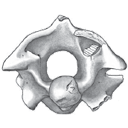
Fossil snakes from the Palaeocene of São José de Itaboraí, Brazil Part III. Ungaliophiinae, Booids incertae sedis, and Caenophidia. Summary, update and discussion of the snake fauna from the locality
Published online: 16/12/2008
Keywords:
booid-grade incertae sedis; Brazil; Caenophidia; New taxa; Palaeocene; Russellophiidae; Snakes; tropidophiids; Ungaliophiinae
https://doi.org/10.18563/pv.36.1-4.37-73
Abstract
Aside from Madtsoiidae, anilioids, and Boidae that were studied previously, the middle Palaeocene of ltaborai (BraziI) has produced Ungaliophiinae ("tropidophiids"), booid-grade snakes incertae sedis, and a possible Russellophiidae (Caenophidia) that are described in the present article. This article is the third and final report on the snakes from the locality. The Ungaliophiinae (Paraungaliophis pricei gen. et sp. nov.) are rare whereas the booid-grade snakes incertae sedis (ltaboraiophis depressus gen. et sp. nov., Paulacoutophis perplexus gen. et sp. nov.) are more frequent. A single vertebra is referred to the Russellophiidae (Caenophidia) with reservation. An update of the whole fauna of snakes from ltaborai is provided. Hechtophis austrinus that was tentatively referred to the erycine Boidae is now regarded as a Boidae incertae sedis. Most snakes from Itaborai are known only from the locality. Astonishingly, only the ailioids Coniophis cf. C. precedens gives possible evidence of interchanges between South and North America. The fauna of snakes from Itaborai, as well as the other Palaeocene faunas of snakes from South America are distinct from those of the Cretaceous and the Eocene of South America; they appear to be more different from the Cretaceous faunas than from those of the Eocene. The fauna from Itaborai is the richest and most diverse assemblage of snakes from the Palaeocene worldwide; it shares only a few taxa with other Palaeocene localities.
PV article infos
Published in Vol. 36, Fasc. 1-4 (2008)
|
PDF
|

|
Les Issiodoromyinae (Rodentia, Theridomyidae) de l'Eocène supérieur à l'Oligocène supérieur en Europe occidentale
Published online: 15/05/1976
Keywords:
climate; Faunal turnover; Paléogène
https://doi.org/10.18563/pv.7.1-2.1-115
Abstract
Based on material from 30 localities, morphologic dental, cranial and biometric analyses have permitted the characterization of two parallel Issiodoromyine lineages, and also the definition of diverse species representing several evolutive stages. Thus it is that new lineages complete the contribution made by the Theridomyinae and Cricetidae and permit, for the Quercy in particular, additional precision in the biochronologic succession of the localities. One of the lineages is limited to the genus Pseudoltinomys LAVOCAT; the other evolves from the genus Elfomys HARTENBERGER to the genus Issiodoromys BRAVARD in GERVAIS. The latter is affected by profound anatomical changes due to a functional modification of the mastication apparatus. These changes seem to be able to be put in relation with the aridification and cooling of the climate at the end of the Eocene. At the end of the middle Oligocene, a new chewing structure is achieved. It is found in diverse living rodents that inhabit a rather arid steppe environment (Cavia, Pedetes, Ctenodactylus). To these supposed nearby ecologic conditions, these rodents have responded in a convergent fashion. It is possible to attribute to the extreme specialization of Issiodoromys its incapacity to adapt to the new climatic crisis of the end of the Oligocene. The arrival of immigrants may be considered as another cause of its disappearance at this time, complementary or not with the first.
PV article infos
Published in Vol. 07, Fasc. 1-2 (1976)
|
PDF
|

|
La variabilité morphologique dentaire du Landenodon (Condylarthra) de Dormaal, (Eocène,Belgique)
Published online: 01/10/1980
Keywords:
Condylarths; Dormaal; Early Eocene; Landenodon
https://doi.org/10.18563/pv.9.ext.167-196
Abstract
The study of dental variations in Landenodon from Dormaal (early Eocene, Belgium) shows that only one
species is present in this locality : L. woutersi QUINET, 1968 (Condylarthra, Arctocyonidae, Arctocyoninae). A high morphological variability is described, especially concerning the metaconid of P/4, the paraconid of M/2, and some characters of M1/ which have been found to be independant of each other. This variability is discussed.
PV article infos
Published in Vol. 9, Ext (1980)
|
PDF
|

|
Carolocoutoia ferigoloi nov. and sp. (Protodidelphidae), a new Paleocene "opossum-like" marsupial from Brazil.
Published online: 15/12/1998
Keywords:
Brazil; Didelphimorphia; Itaborai; Marsupialia; New taxa; Paleocene; Protodidelphidae; South America
https://doi.org/10.18563/pv.27.3-4.145-154
Abstract
Carolocoutoia ferigoloi gen. et sp. nov. is the largest of protodidelphid marsupials, known from Middle Paleocene levels at Itaboraí Formation, southeastern Brazil. It differs from other members of this family in having molars with low cusps which are basally inflated, rounded crests without cutting edges, and a thick enamel layer which is wrinkled, specially at the labial half. A comparative analysis among representatives of this family led us to recognize only three genera undoubtely assignable to it: Protodidelphis PAULA COUTO, 1952, Robertbutleria MARSHALL, 1987, and Carolocoutoia gen. nov. Protodidelphids lack the basic derived features diagnostic of Polydolopimorphian marsupials, while most of its derived features agree with its belonging to the Didelphimorphia. Protodidelphids comprise a specialized clade of opossum-like marsupials adapted to frugivorous or frugivore-omnivorous feeding habits. They differ from other didelphimorphians in having very large, spire-like entoconids, reduced and antero-posteriorly compressed paraconids, absence of stylar cusp C and of para- and metaconules, large stylar cusps B and D which are proximate to each other, short postmetacristae, eccentric protocones, and molars that increase rapidly in size from M/ml to M/m3.
PV article infos
Published in Vol. 27, Fasc. 3-4 (1998)
|
PDF
|