
Abstract book of the 18th Conference of the EAVP
Pterosaurs from Coahuila
New elephant cranium from early Pliocene Ileret, Kenya
Les sélaciens du Miocène de la région de Montpellier
Muridae du Pliocène supérieur d'Espagne et du midi de la France.
Contribution à l'étude des genres Gliravus et Microparamys.
Eocene (57) , Quercy Phosphorites (38) , Systematics (32) , Rodents (29) , Mammalia (27) , Rodentia (25) , Miocene (25)
Page 16 of 19, showing 20 record(s) out of 366 total

|
Fossil snakes from the Palaeocene of Sao José de Itaborai, Brazil.Part 1 Madtsoiidae, Aniliidae.Jean-Claude Rage
Published online: 15/12/1998 |
|

|
Révision des Artiodactyles de l'Eocène moyen de Lissieu (Rhône)Jean SudrePublished online: 15/05/1972Keywords: Artiodactyles; Dichodon; France https://doi.org/10.18563/pv.5.4.111-156 Abstract The object of this work is the study of the artiodactyls of the karstic locality of Lissieu near Lyon. Among the sixteen species counted, five (Hyperdichobune nobilis, Hyperdichobune sp., Haplabunodon mulleri, Tapirulus depereti and Pseudamphimeryx schlosseri) are cited for the first time in this fauna. The description of part of the anterior dentition of «Dichobune» langi permits the referal of this species to the genus Hyperdichobune. The new selenodont species Dichodon lugdunensis described in this work belongs, with its ancestor Dichodon simplex, to a lineage distinct from that of Dichodan cartieri and Dichodon ruetimeyeri. Finally, the taxonomic reality of the Lissieu species, Lophiobunodon rhodanicum Deperet, is justified. All the other species have been compared with those of Egerkingen. Even though with most of them no difference in age can be shown between the two deposits, some however indicate clearly by their degree of evolution that Lissieu is slightly more recent than Egerkingen. ln the history of Eocene mammals, the Lissieu fauna, because of its homogeneity, can be considered as a sure reference fauna of the Auversian period. PV article infos Published in Vol. 05, Fasc. 4 (1972) |
|

|
First report of an Eocene reptile fauna from Florida, USAAlan J. HolmanPublished online: 30/07/2001Keywords: Eocene; Fauna; Florida; Reptile; USA https://doi.org/10.18563/pv.30.1-2.1-10 Abstract Fossils of the Trionychidae, Bataguridae or Emydidae, Palaeophis and Crocodylia from Chattahoochee, NW Florida, USA, represent the first report of an Eocene reptile fauna from Florida. PV article infos Published in Vol. 30, Fasc. 1-2 (2001) |
|

|
The paramyid rodent Ailuravus from the middle and late Eocene of Europe, and its relationshipsAlbert E. WoodPublished online: 15/05/1976Keywords: Ailuravinae; Rodentia https://doi.org/10.18563/pv.7.1-2.117-149 Abstract The complex taxonomic history of the paramyid rodent genus Ailuravus is reviewed. It has been described as Hyracotherium, as a creodont carnivore and as a lemuroid primate - errors at the ordínal level that are most unusual for a rodent. The genus is a member of the poorly known subfamily Ailuravinae, probably derived from some European Early Eocene species of Paramys. Aíluravus was a large arboreal paramyid with highly rugose cheek teeth, very well developed hypocone, and a remarkably weak lower incisor. It was tropical to subtropical. Three named species are recognized, A. macrurus from the Lutetian of Messel; the genotype, A. picteti, from Egerkingen, Buchsweiler and the Geiseltal, slightly later in the Lutetian; and A. stehlinschaubi, new name, from the Bartonian of Mormont-Eclépens and Robiac. One or more unnamed species are present in the Ypresian of Cuis. The species are close to a phyletic sequence. No later representatives of the genus are known. The late Eocene to earliest Oligocene North American paramyid Mytonomys, whose relationships have been obscure, is tentatively referred to the Ailuravinae. PV article infos Published in Vol. 07, Fasc. 1-2 (1976) |
|

|
Une faunule de vertébrés sous la base de grès de Celas (Eocène supérieur) à ST Dresery (Gard)Jean-Albert RemyPublished online: 20/05/1994Keywords: Artiodactyla; Biostratigraphy; Eocene; Mammals https://doi.org/10.18563/pv.23.1-4.211-216 Abstract The St-Dézéry local fauna (3 reptile-, 4 mammal species) is approximately of the same age as the La Débruge or the Ste-Néboule faunas. It conduces to a better dating of the limestones underlying the Célas sandstones. A large part of a mandible of Amphimeryx was found there, which documents the record of this family of small artiodactyls PV article infos Published in Vol. 23, Fasc. 1-4 (1994) |
|

|
Acinoptèrygiens du Stéphanien de Montceau-les-Mines (Saône-et-Loire, France).Daniel Heyler and Cécile PoplinPublished online: 30/09/1983Keywords: Aeduelliforms; Biogeography; Palaeonisciforms; paramblypteriforms; Stephanien https://doi.org/10.18563/pv.13.3.33-50 Abstract The study of new specimens from the Stephanian shales of Montceau-les-Mines confirms and enlarges the number of groups already known in this area. Among the Palaeonisciforms, “form A" is now known more completely, although no diagnosis or name can yet be given for it. “Form B" is redescribed and its relationships with “Elonichthys robisoni" are discussed. A palaeoniscid is recorded which resembles those from Bourbon l'Archambault. The paramblypteriforms occur rather frequently, but no genera can be determined. The aeduelliforms comprise some specimens close to Aeduella blainvíllei from Muse (Autun basin), and a new genus. Comparison of the latter with two fossils from Lally allows creation of two new species and a new family. This diversification of the aeduelliforms during this middle Stephanian leads to the hypothesis that the group originated at least as early the lower Stephanian. This material prooves again the characteristic endemism of this fauna, particularly of the aeduelliforms which are known only in the Massif Central where they diversified during the Permo-Carboniferous. Biogeographical consequences are discussed. PV article infos Published in Vol. 13, Fasc. 3 (1983) |
|
|
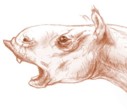
There were giants upon the earth in those daysPierre-Olivier Antoine
Published online: 16/07/2014 |
|

|
La poche à phosphate de Ste-Néboule (Lot) et sa faune de vertebres du Ludien supérieur. 11- CréodontesBrigitte Lange-BadréPublished online: 25/09/1978Keywords: Creodonta; Eocene; Quercy Phosphorites https://doi.org/10.18563/pv.8.2-4.295-299 Abstract The teeth and the astragale of the Creodonta from Ste-Néboule (Lot) are referred to Hyaenodon brachyrhynchus. Isolated teeth fit morphologically the material from La Débruge (Middle Ludian). However, biometric analysis suggests an Upper Ludian age. PV article infos Published in Vol. 08, Fasc. 2-4 (1978) |
|

|
Rongeurs Caviomorphes de l'Oligocène de Bolivie. 2 Rongeurs du Bassin Deseadien de Salla-Luribat.René LavocatPublished online: 01/08/1976Keywords: cranium; Paleobiogeography; Rodentia https://doi.org/10.18563/pv.7.3.15-71 Abstract The fauna studied in the following work involves the dentitions and skulls more or less complete of 5 genera, among which only Cephalomys was previously known by its skull. One must notice that the Salla's species of this genus is a new one. Sallamys, rather small, shows a dentition rather similar to that of Platypittamys Wood from Patagonia. The upper molars, more primitive than those of this last genus, according to the smaller dimensions of the hypocone, retain a distinct metaloph. This metaloph tends to be reduced in a way which may give us a possibility to understand how it disappeared in Platypittamys. The upper P4 can be compared as well to that of Platypittamys as to that of Gaudeamus from the African Oligocene. The lower P4, more molarized than that of Platypittamys, is already moving towards the miocene type of structure. The infraorbital foramen is wide and the insertion of the masseter on the muzzle is spacious. Branisamys, genus of a great size, shows an auditory region partly preserved, peculiarly the promontorium with the fenestra rotunda, entirely of the Hystricognathi type. Upper molars are very clearly pentalophodont. A new reconstruction is proposed for the tooth called Villarroelomys by Hartenberger. This tooth is shown to be a lower D4, perhaps of Branisamys , certainly of a rather nearly allied form, and Hartenberger does agree with the essential part of this new conclusion. Of Incamys, two incomplete skulls are known, each one being admitted to be the type of a distinct species, the first one being I. bolivianus, I. pretiosus the second. The infraorbital foramen is of a great size and the impression of the masseter on the muzzle is spacious. The sphenopalatine foramen is widely developed and of a really very uncommon great size. Only Thryonomys from Africa shows a similar tendency to the enlargement of this foramen, but not so extreme. The main basicranial foramina can be observed. The upper teeth, hemi-hypsodont, show, either a vestigial metaloph, similar to that of recent Thryonomys from Africa, associated with a well developed mesoloph, either a well developed metaloph, while the mesoloph is reduced or absent. Cephalomys was previously known by anterior parts of the skull showing a wide infraorbital foramen and a spacious facial insertion of the masseter. Its lacrymal is of the phiomorph type and the spheno-palatine foramen is seemingly of great size, like in Incamys. The species is new. The varied peculiarities of the upper teeth of these genera can be easily understood if we refer to the plan of the teeth of Phiomys andrewsi from the Oligocene and Miocene of Africa. The structure of this genus, clearly more primitive, still typically brachyodont, shows and clearly explains the fundamental coherence of the varied realisations arised from such a structure. Luribayomys n.g. is known only by an anterior half of a skull without teeth. It is remarquable by the great development of the masseter's insertions on the muzzle and by the lacrymal region, well preserved, typically phiomorphid. The classification previously published by A.E. Wood and B. Patterson is granted in its essential parts, provisionally, but not as a definitive solution. Nevertheless the Dasyproctidae are integrated within the Cavioidea, following the conclusions of Bugge and of Vucetich, reached independently. The conclusion emphasizes the exceptional meaning of the fauna of Salla-Luribay. This shows that Platypittamys, while interesting, can no more be supposed certainly representative of the normal structure of the Oligocene Caviomorph, and not even of their ancestors. The anatomical peculiarities exhibited in these new samples, auditory region, lacrymal, spheno-palatine foramen, reinforce the primitive structural identity with the Phiomorpha. Similarly, the new lower D4 favour very close relationships, ever if the affinities of the D4 has been questioned or minimized by Wood and Patterson. It is certainly possible to admit that parallelism could explain limited similarities, like the presence in North America of Rodents with an hystricomorph type of infraorbital foramen and an hystricognath mandible. But if the parallelism could be a sufficient explanation of the identical association of multiple and complete structures observed in the Caviomorpha and Phiomorpha, all the Zoological systematic would have to be questioned. The last positions of A.E. Wood on the subject (1975) are revised and criticised, and the recent publications studying the problems of distance between Africa and South America in Eocene time, as a consequence of the drift, are quoted; the possibility of transportation by rafts is shown. A new hypothesis is proposed about the interrelationships of Pentalophodont Rodents, with interesting paleobiogeographic implications. PV article infos Published in Vol. 07, Fasc. 3 (1976) |
|

|
Description des rongeurs Pliocènes de la faune du Mont-Hélène (Pyrénées-Orientales, France), nouveau jalon entre les faunes de Perpignan (Serrat-d'en-Vacquer) et de Sète.Jean-Pierre Aguilar, Marc Calvet
Published online: 31/10/1986 |
|

|
Contributions à l'étude du gisement Miocène supérieur de Montredon (Hérault). Les grands mammifères. 6 - Les périssodactyles RhinocerotidaeClaude GuérinPublished online: 15/11/1988Keywords: Aceratherium; anatomy; Biostratigraphy; Dicerorhinus; Miocene; Montredon; Paleoecology; Upper Vallesian https://doi.org/10.18563/pv.18.ext.3-7-134 Abstract The Montredon site has yielded about hundred rhinoceros remains: PV article infos Published in Vol. 18, Ext (1988) |
|

|
Rates of evolution in divergent species lineages as a test of character displacement in the fossil record : tooth size in Paleocene Plesiadapis (Mammalia, Proprimates)Phillip D. Gingerich
Published online: 16/12/1996 |
|

|
Un nouveau chiroptère vespertilionide de l'Oligocène d'EuropeBernard Sigé and Henri MenuPublished online: 17/12/1992Keywords: bats; Europe; nov. sp.; Oligocene; Vespertilionid https://doi.org/10.18563/pv.22.1.45-48 Abstract A fossil species of the extant genus Leuconoe, L. lavocati n. sp. from Le Garouillas Oligocene locality, Quercy phosphorites, SW-France, is established in nomenclatural standards. PV article infos Published in Vol. 22, Fasc. 1 (1992) |
|

|
Premier signalement du Monachinae (Phocidae, Mammalia) dans le Sahélien (Miocène supérieur) d'Oran (Algérie)Christian de Muizon
Published online: 15/10/1981 |
|

|
Introduction à l'oeuvre scientifique de Donald E. Russell, "gentleman paleontologist"Marc Godinot
Published online: 16/12/1996 |
|

|
Hyracodontids and rhinocerotids (Mammalia, Perissodactyla, Rhinocerotoidea) from the Paleogene of MongoliaDemberelyin DashzevegPublished online: 29/10/1991Keywords: Hyracodontidae; Mongolia; Paléogène; Perissodactyla; Rhinocerotidae https://doi.org/10.18563/pv.21.1-2.1-84 Abstract Two families are reviewed (Hyracodontidae and Rhinocerotidae) from the Paleogene of Mongolia. The following taxa are described from the former family: Triplopus? mergenensis sp. nov., Prohyracodon meridionale CHOW, Prohyracodon? parvus sp. nov., Forstercooperia ergiliinensis GABUNIA & DASHZEVEG, Ardynia praecox MATTHEW & GRANGER, A. mongoliensis (BELIAYEVA), Ardynia sp., Urtinotheríum sp. (or Indricotherium) and Armania asiana GABUNIA & DASHZEVEG. All of them are from the Paleogene of the eastem Gobi Desert The hyracodontid Pataecops parvus RADINSKY is described from a new locality, Menkhen-Teg (Middle Eocene), in the Valley of Lakes. PV article infos Published in Vol. 21, Fasc. 1-2 (1991) |
|

|
Archosauriform teeth from the upper Triassic of Saint Nicolas-de-Port (Northeastern France).Pascal Godefroit
Published online: 15/12/1997 |
|

|
Second international symposium on Dinosaur, Eggs and Babies (Montpellier-Aix-en-Provence, 25-29 Août 2003).Monique Vianey-Liaud
Published online: 15/12/2003 |
|

|
Les rongeurs de l'Oligocène inférieur d'EscampsMonique Vianey-Liaud
Published online: 01/12/1974 |
|

|
Analyse d'ouvrage : Koobi Fora Research Project, volume 3. The fossil ungulates: geology, fossil artiodactyls, and palaeoenvironments, édité par John Michael HARRIS, 1991. Clarendon Press, Oxford, xvi + 384 p. ISBN 0-19-857399-5.Jean SudrePublished online: 11/02/1993Keywords: Artiodactyls; palaeovenvironments; Ungulates https://doi.org/10.18563/pv.22.2-3.138-139 Abstract Avec ce volume se clôture l'étude géologique et paléontologique des sites à hominidés de Koobi Fora. Il fait suite aux deux précédents ouvrages, parus respectivement en 1978 et 1983, consacrés également à l'étude des faunes recueillies sur ces gisements dans le cadre du Koobi Fora Research Project. PV article infos Published in Vol. 22, Fasc. 2-3 (1993) |
|
