
Abstract book of the 18th Conference of the EAVP
Pterosaurs from Coahuila
New elephant cranium from early Pliocene Ileret, Kenya
Les sélaciens du Miocène de la région de Montpellier
Muridae du Pliocène supérieur d'Espagne et du midi de la France.
Contribution à l'étude des genres Gliravus et Microparamys.
Eocene (57) , Quercy Phosphorites (38) , Systematics (32) , Rodents (29) , Mammalia (27) , Rodentia (25) , Miocene (25)

|
Les traces de pas d'amphibiens, de dinosaures et autres reptiles du Mesozoïque Français : inventaire et interprétations.Georges Gand, Georges Demathieu and Christian MontenatPublished online: 15/12/2007Keywords: Footprints; France; Inventory; Mesozoic; palaeontology; palaeovenvironments; Stratigraphy https://doi.org/10.18563/pv.35.1-4.1-149 Abstract Since the 19th century, thousands of footprints were observed in the geological series of the French Mesozoic. All are located in the Triassic and Jurassic. After a promising beginning, in France, it is only a few papers which will be published in the first half 20th century, unlike the USA and of others countries of Western Europe. One ought to wait about 1950 for a revival and now they are nearly 200 papers which were devoted to the ichnofossils. The literature abundance and the renewed interest of the naturalists for the palichnologic studies decided to us to write a synthesis work. This one begins with a stratigraphic inventory in which, localisation, age and paleontological contents of about 180 fossiliferous sites are specified. After having pointed out the followed methods, the footprints paleontological interpretation is then approached in detail and the results obtained are replaced in stratigraphy to deduce the fauna evolution during the Mesozoic. So, it appears that Ichnologic data, more varied and rich in the Triassic and Liassic than those relating to the bones, very rare for the considered periods, are very informative. The middle Triassic (Anisian-Ladinian), thus reveals Cotylosauria, Lepidosauria, Crurotarsi with Rauisuchia, Ornithosuchidae, Crocodylia and Dinosauromorpha more the "Prodinosauria": Dinosamiforme whose skeletons are known in Argentina but only in Ladinian. The rather fast domination of Dinosaurs during Norian is also as well shown. The almost exclusive presence of their footprints, up to fifty cm long, in the Lower Hettangian indicates their supremacy in the environments. Footprints characterise not very deep life places located between inter-supratidal limits and often out of water. Sedimentologic and Palaeontologic studies showed that they were great coastal spaces during Middle Triassic, flood-plain with sebkhas while Upper Triassic, and a large !!coastal marsh!! in Grands-Causses during Liassic in which, mainly, fine stromatolithic layers were deposited. During the same periad, bay beaches spread in Vendée. During the Middle Jurassic, they are also brackish to lacustrine environments and recifallagoons in- the Upper Jurassic. Numerous measurements of the footprints and trackways directions showed that the animaIs moved there in weil defined directions, for long periods. They seem due to the palaeotopography of the life environments relatively stable. Also, the discovery of vegetal radicular networks and small footprints far away from the continental borderlands has suggested that the animals continuously lived in these palaeoenvironnements, belonging to large ecosystems, where the sedimentation rate was weak. This explains that thebadies could not fossilize there but only their footprints through the cyanobacterian action in main cases. From the vertical distribution of different ichnospecies, defined with adapted statistical methods, explained in this work, a palichnostratigraphy was established for the Middle Triassic. Although the footprints are also abundant in Hettango-Sinemurian of "Grands-Causses" and the Vendée, it was not possible, up to now, to establish any zonation in this series; Probably because the palichnofauna is too little diversified there, currently reduced to a majority of Theropods II-IV tridactyl traces. PV article infos Published in Vol. 35, Fasc. 1-4 (2007) |
|

|
Contributions à l'étude du gisement Miocène supérieur de Montredon (Hérault). Les grands mammifères. 4 - Les artiodactyles Suidae.Léonard GinsburgPublished online: 15/11/1988Keywords: Artiodactyla; France; Mammalia; Montredon; Upper Miocene https://doi.org/10.18563/pv.18.ext.57-64 Abstract There is only one suid known in the Upper Miocene of Montredon (Hérault): Microstonyx (Limnostonyx nov. subgen.) antiquus (KAUP). It is differenciated from Microstonyx major by the presence of upper and lower canines which are considerably longer and biger. Its presence at Montredon corroborates the palustrine habitat for the species. PV article infos Published in Vol. 18, Ext (1988) |
|

|
The Ctenodactylidae (Rodentia) from the Oligocene of Ulantatal (inner Mongolia, China)Monique Vianey-Liaud
Published online: 15/12/2006 |
|

|
Rythme et modalités de l'évolution chez les rongeurs à la fin de l'Oligocène-leurs relations avec les changements de l'environnement.Bernard ComtePublished online: 15/12/2000Keywords: Environment; evolution; Oligocene; Rodents; Systematics https://doi.org/10.18563/pv.29.2-4.83-360 Abstract The analysis of oxygene isotope variations as well as paleobotanical data suggest that the Oligocene/Miocene boundary corresponds to a transitional period marked by floristical and climatic variations. During this period, the pyreneo-alpine tectonics has contribued to modify the geography and western Europe landscapes. Faunal changes (appearances, extinctions, migrations) are observed in different mammalian groups, notably in the rodents. A study of the evolutionary trends and patterns in paleogene rodents is involved for the period ranging from level MP 28 of the Late Oligocene to the Early Miocene, including the Oligo-Miocene boundary. PV article infos Published in Vol. 29, Fasc. 2-4 (2000) |
|

|
The Pleistocene vertebrate fauna of Robinson Cave, Overton County, TennesseeJ. E. Guilday, H. W. Hamilton and A. D. Mc CradyPublished online: 20/01/1969Keywords: Fauna; Mammalia; Pleistocene; Tennessee https://doi.org/10.18563/pv.2.2.25-75 Abstract A late Pleistocene deposit of 60 species of vertebrates and 12 of invertebrates is described from Robinson Cave, Overton County, Tennessee, U.S.A. Forty-eight species of mammals are represented by at least 2,483 individuals; 10 % are extinct, 10 % occur in the state only as boreal relicts in the Great Smoky Mountains; 23 % no longer occur as far south as Tennessee; 57 % occur at or near the site today. Nínety-one percent of the Recent mammal species can be found living today in the Minnesota-Wisconsin area, approximately 10 degrees farther north. Fluorine analysis suggests a long period of accumulation. The following 10 mammalian species are recorded from Tennessee for the first time. Sorex arcticus, Microsorex hoyi, Citellus tridecemlineatus, Clethrionomys gapperi, Microtus pennsylvanicus, Synaptomys cooperi, Synaptomys borealis, Zapus nudsonius, Napaeozapus insignis, Martes americana. Six additional species are present as boreal relicts in the Great Smoky Mountains of eastern Tennessee but not at the site today : Sorex cinereus, Sorex dispar, Sorex palustris, Parascalops breweri, Glaucomys sabrinus, Mustela nivalis. Six forms are extinct: Canis dirus, Ursus americanus amplidens, Sangamona furtiva, Dasypus bellus, Mammut americanus,Megalonyx jeffersoni. Twenty-six additional species of mammals, all of the snails, birds, reptiles, and amphibians recovered from the fauna still inhabit the area today: The fauna is indicative of a cold-temperate climatic episode associated with the Wisconsin glaciation, but may be chronologically mixed. PV article infos Published in Vol. 02, Fasc. 2 (1969) |
|
|
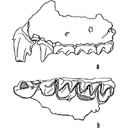
Les Chiroptères du Miocène inférieur de Bouzigues. 1- Etude systématique.Bernard SigéPublished online: 17/04/1968Keywords: bats https://doi.org/10.18563/pv.1.3.65-133 Abstract In recent years, the techniques of chemical preparing have permitted a rich paleontologic material to be obtained from the phosporitic sediment of Bouzigues (Hérault, France). The fauna of this locality is comprised of quite varied microvertebrates, amphibians, reptiles, birds, mammals. Twenty five species of the latter, belonging to seven orders, are today known from the site. Among them, the numerous rodents have allowed L. Thaler to chronologically situate this fauna in the Zone of Laugnac (<< late Aquitanian ›> of some authors). PV article infos Published in Vol. 01, Fasc. 3 (1968) |
|

|
Contributions à l'étude du gisement Miocène supérieur de Montredon (Hérault). Les grands mammifères. 3 - Les artiodactyles ruminantsLéonard Ginsburg and Herbert ThomasPublished online: 15/11/1988Keywords: Artiodactyla; France; Montredon; Ruminentia; Upper Miocene https://doi.org/10.18563/pv.18.ext.43-56 Abstract The remains of Ruminantia are very rare at Montredon. No specific determination was possible. We have only one Micromeryx, one small cervid, one tragocere and one (?) gazella. The faunal spectrum is in good correlation with the general retreat of the cervids in the European upper Miocene, but in contrast it is not convenient for the bovids, which are in expansion at the same time. For them, we have to invoke the local ecological conditions. PV article infos Published in Vol. 18, Ext (1988) |
|

|
Le genre Leptolophus (Perissodactyla, Mammalia): morphologie et histologie dentaires, anatomie cranienne, implications fonctionnelles.Jean-Albert RemyPublished online: 15/09/1998Keywords: dental histology; Eocene; functional anatomy; Palaeotheriidae; skull anatomy; Southern France; Systematics https://doi.org/10.18563/pv.27.1-2.45-108 Abstract A strong lophodonty, an extreme heterodonty, some hypsodonty and regular overlayings of coronal cement are prominent features of the genus Leptolophus (Palaeotheriinae = Palaeotheriidae s.s.). The histological pattern of the teeth unusually joins type II enamel prisms, characteristic of advanced ungulates, together with archaic features, such as an almost complete lack of Hunter-Schreger zonation and a weak expanse of peritubular dentine. The skull is narrow and slender, with an elongated ante-orbital facial region, a moderately notched nasal aperture, a rather elongated post-canine diastem, parallel zygornatic arches and a fairly dorsally located squamoso-mandibular joint.The functional analysis brings to light "ectolophodont" masticatory cycles with two phases, in which maximum power was applied, contrary to equíds, on hindmost teeth; likewise, skull accomodations to increasing height of the teeth are quite different. This study leads to the assumption that Leptolophus may have been light mammals, living in rather open surroundings, browsing on herbaceous plants or leaves cropped close to the ground. Moreover, it appears that it could have been some inadequacy of dental structures to the dietary, which leaded to quick wear of the teeth and to many enamel notches, but had been somewhat balanced by the early increase of hypsodonty, not induced in such a case by a biotop deterioration (as it will happen at the end of the Eocene). This ínadaptation might account for the short duration of the genus Leptolophus, whose the 3 species, L. stehlini, L. nouletí and L. magnus n. sp. are indeed confined in the level MP 16. Its geographical spreading (as far as known, South of western Europe) and the morphological pattern of its dentition suggest that this genus would have been related to early upper Eocene endemic spanish forms. PV article infos Published in Vol. 27, Fasc. 1-2 (1998) |
|

|
Artiodactyla aus den Eozänen Braunkohlen des Geiseltales bei Halle (DDR)Jorg Erfurt and Hartmut HauboldPublished online: 04/12/1989Keywords: Artiodactyles; Eocene; Europe; Paleoecology; Stratigraphy; taxonomy https://doi.org/10.18563/pv.19.3.131-160 Abstract The present study of Artiodactyla from the Middle Eocene of the Geiseltal lignite beds concems systematics, biostratigraphy, and palaeoecology on the basis of 174 specimens: isolated remains to more complete skeletons. Instead of the formerly known five species of two families are now recognized 14 species of the Diacodexeidae, Dichobunidae, Cebochoeridae, and Haplobunodontidae. New species are Aumelasia maniai, Anthracobunodon neumarkensis, Masillabune franzeni. Four species of the Geiseltalfauna are definitely known from elswere, and five species are closely related to those from other European localities. Evidently the faunal situation of artiodactyls during the Middle Eocene of Europe was largely uniform. The distribution of artiodactyls within the sequence of the Geiseltal strata corroborates the biostratigraphical concept of the land mammal age Geiseltalian (Franzen & Haubold l986b) as well as the mammalian reference levels MP 11-13 (Franzen 1987). Reconstructions of the skulls and skeletons allow conclusions on the functional morphology and palaeoecology of the artiodactyls of the European Middle Eocene PV article infos Published in Vol. 19, Fasc. 3 (1989) |
|

|
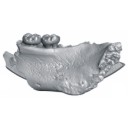
Agriotherium intermedium (Stach 1957) from a Pliocene fissure filling of Xiaoxian County (Anhuei Province, China) and the phylogenetic position of the genus.Zhanxiang Qiu and Norbert Schmidt-KittlerPublished online: 30/09/1983Keywords: Carnivora; China; PHYLOGENY; Pliocene; skull anatomy; Ursidae https://doi.org/10.18563/pv.13.3.65-81 Abstract A fragmentary mandible and maxilla of a small sized Agriotherium of a young individual discovered from a Pliocene fissure filling in Xiaoxian county (Anhuei Province, China) are described. Judging from the morphology of the dentition and its dimensions the new material can be identified as Agriotherium inlermedium (STACH l957). Hendey's proposition (1980) that the Agriotherium species are derived from Indarctos is reconsídered on the basis of the new documents. As a result of a more general phylogenetic discussion it can be stated, that: 1. the supposed size increase as well as other trends, leading from Indarctos to Agriotherium are untenable ; 2. there are no positive indications to assume a phylogenetic transition of these two genera. 3. there are no real arguments in favor of an adaptational reversal in the evolution of Agriotherium. Hence, many features of that genus supposed by Hendey to be derived are plesiomorphic ; 4. regardless of the previous points it is methodologícally impossible to establish direct ancestor - descendant relationships between Indarctos and Agriotherium species, as Hendey did. Based on the data available and especially on the characters of the new material from China it is more likely that Agriotherium and Indarctos are two genera which developed independently. While advanced Agriotherium species, e.g. A. africanum, resemble in some respects Indarctos by adaptational analogies, more primitive species, e.g. Agriotherium intermedium, are quite dissimilar to lndarctos. While Indarctos might be derived from an Ursavus like forerunner, Agriotherium has its roots more likely somewhere in between Ursavus and the Hemicyon-group. PV article infos Published in Vol. 13, Fasc. 3 (1983) |
|
|
Enigmatic rodents from Lavergne, a late middle Eocene (MP 16) fissure-filling of the Quercy Phosphorites (Southwest France)
|
|

|
A new rodent from Quaternary deposits of the Canary Islands and its relationships with Neogène and recent murids of Europe and Africa.Rainer Hutterer
Published online: 15/12/1988 |
|

|
Les Bovidae (Artiodactyla, Mammalia) du Miocène moyen de la formation Hofuf (Province du Hasa, Arabie Saoudite).Herbert ThomasPublished online: 30/12/1983Keywords: Biostratigraphy; Bovidae; Middle Miocene; Palaeogeography; Saudi Arabia https://doi.org/10.18563/pv.13.5.157-206 Abstract The study of the bovids from Al Jadidah (Hofuf Formation, Saudi Arabia) confirms that the fauna comes from a pre-Hipparion level. The Al Jadidah age is close to that of Fort Ternan (14 m.y.) and Beni Mellal, but cannot be older than that of Fort Ternan. The age of the Hofuf Formation is close to but slightly older than the oldest deposits of the Ngorora Formation (Kenya). 7 to 9 species have been recorded, of which 2 to 4 remain indeterminate. If the great specific diversity of te bovids from this locality gives evidence of immigrations from anterior Asia (Turkey) (e.g. Pachytragus Iigabuei sp. nov.), the bovid assemblage of Al Jadidah results in fact from a double influence: from the anterior Asia and mainly from Africa (e.g. the Caprotragoides lineage and the Neotragini? Homoiodorcas). The Al Jadidah bovids reflect, on the whole, the predominant character of open to very open environment, which supports the conclusions drawn from our two preliminary studies. PV article infos Published in Vol. 13, Fasc. 5 (1983) |
|
|
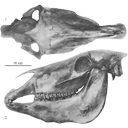
Old world hemiones and new world slender species (Mammalia, Equidae)Véra Eisenmann, John Howe and Mario PichardoPublished online: 16/12/2008Keywords: Amerhippus; biometry; Equus; Holocene; New World; Old World; Osteology; Pleistocene; Pliocene https://doi.org/10.18563/pv.36.1-4.159-233 Abstract Morphological and biometrical description of skulls, teeth, and limb bones of extant and fossil Old World herniones (including E. hydruntinus) and of New World 'stilt-Iegged' and other slender species from Blancan to Holocene. An Appendix presents ways in which the approximate size of some missing bones or dimensions may be deduced from available ones. PV article infos Published in Vol. 36, Fasc. 1-4 (2008) |
|
|
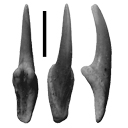
Additions to the elasmobranch assemblage from the Bandah Formation (middle Eocene, Bartonian), Jaisalmer District, Rajasthan, India, and the palaeobiogeographic implications of the faunaRajendra S. Rana
Published online: 23/06/2021 |
|

|
Die Ohr-Region der Paulchoffatiidae (Multituberculata, Ober-Jura).Gerhard HahnPublished online: 15/11/1988Keywords: Multituberculata; Ober-Jura; Paulchoffatiidae; Petrosum; Portugal https://doi.org/10.18563/pv.18.3.155-185 Abstract The petrosal of the Paulchoffatiidae HAHN, 1969 is described and compared with that of younger multituberculates and of other Mesozoic mammals. The "Morrison petrosal", described by Prothero (1983), is also discussed; it probably belongs to the multituberculates. The reconstruction of the ventral side of the Paulchoffatiinae-skull, given by Hahn in 1987, is completed by addition of the otic and the occipital region. PV article infos Published in Vol. 18, Fasc. 3 (1988) |
|
|
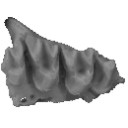
A new species of bat (Chiroptera: Vespertilionidae) from the early Oligocene global cooling period, Brule Formation, North Dakota, USANicholas Czaplewski
Published online: 09/12/2019 |
|
|
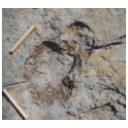
Small sauropod tracks in the Hettangian of Southern France – A case of ichnite fossilization in an intertidal zonePierre Demathieu, Alain Izart, André Charrière
Published online: 28/06/2022 |
|

|
Macroscelidea, Insectivora and Chiroptera from the Miocene of east Africa.Percy M. ButlerPublished online: 15/11/1984Keywords: Chiroptera; East Africa; Insectivora; Macroscelidea; Miocene; Systematics https://doi.org/10.18563/pv.14.3.117-198 Abstract The East African Miocene Macroscelidea, lnsectivora and Chiroptera are revised on the basis of new material. New taxa proposed are: Miorhynchocyon, .n. gen. (Macroscelididae): Míorhynchocyon meswae, n. sp.: Pronasílío ternanensis. n. gen.. n. sp. (Macroscelididae); Hiwegicyon juvenalis, n. gen. n. sp. (Macroscelididae); Parageogale, n. gen. (Tenrecidae): Prochrysochlorinae, n. subfam. (Chrysochloridae): Propottininae, n. subfam, (Pteropodidae); Chamtwaria pickfordi, n. gen., n. sp. (Vespertilionidae). Gymnurechnínus songhorensis is synonymised with G. camptolophus. The new material provides additional information on the dentition, especially of Myohyrax oswaldi. Galerix africanus. Amphechínus rusingensis, Protenrec tricuspis and Parageogale aletris. Partial skulls are described of Amphechinus rusingensis, Protenrec tricuspis, Prochrysochloris míocaenicus and Taphozous incognita. The oldest member of the Macroscelidinae (Pronasilio) is described from Fort Ternan. Galerix africanus is closely related to G. exilis from Europe. Amphechinus rusingenesis is compared with Asiatic Oligocene Erinaceinae. The Miocene age of Crocidura is rejected. On the evidence of humeri, the following families of Chiroptera are newly reported: Pteropodidae, Nycterididae, Vespertilionidae, Molossidae. Propotto is regarded as an offshoot from the Pteropodidae, not ancestral to modern forms. Chamtwaria is a primitive vespertilionoid, provisionally placed in the Kerivoulinae. Erinaceidae probably entered Africa at the beginning of the Miocene, before 20 Ma. Faunistic differences between deposits are largely to be ascribed to differences in local environment. PV article infos Published in Vol. 14, Fasc. 3 (1984) |
|

|
Les gangas (Aves, Columbiformes, Pteroclidae) du Paléocène et du Miocène inférieur de France.Cécile Mourer-Chauviré
Published online: 11/02/1993 |
|
