|
Les Gruiformes (Aves) des phosphorites du Quercy (France). 1. sous-ordre cariamae (Cariamidae et Phorusrhacidae), systématique et biostratigraphie.
Published online: 30/11/1983
Keywords:
Aves; Biostratigraphy; Birds; Cariamae; gruiformes; Quercy Phosphorites; Systematics
https://doi.org/10.18563/pv.13.4.83-143
Abstract
The revision of the old collections of fossil birds from the “Phosphorites du Quercy” and the study of new material give the following results (Gruiformes, Cariamae) : The humeri and most of the carpometacarpi described under the name Filholornis belong in Elaphrocnemus. The ulnae ascribed to Fïlholornis belong in Idiornis. Most of the post-cranial elements of the genera Elaphrocnemus and Idiornis are described and show great similarities with recent Cariamidae and Opisthocomidae, and fossil Bathornithinae. A new genus and a new species, Oblitavis insolitus, are created in the sub-family Idiornithinae; two new species are described in the genera Elaphrocnemus (E. brodkorbz) and Idiornis (I. itardiensis), and the species Elaphrocnemus gracilis is transferred to the genus Idiornis. The genus Propelargus Lydekker is transferred from the family Ciconiidae to Cariamidae. A new generic name, Occitaniavis, is created for the species Geranopsis elatus, which belong in Cariamidae, while the type-species of the genus, Geranopsis hastingsiae, is a member of the Gruidae. The affinities between the Quercy avifauna and the Neotropical one is emphasized by the occurrence of Phorusrhacidae, previously known only from the Cenozoic of South America and the Late Pliocene or Early Pleistocene of North America. Thanks to the material collected during the new excavations, the stratigraphical position of most of the species is stated precisely, and evolutionary lineages are outlined. This study shows that the suborder Cariamae, presently restricted to two South American genera, was already extremely diversified during the Eocene, and widespread in Europe and North America.
PV article infos
Published in Vol. 13, Fasc. 4 (1983)
|
PDF
|
|
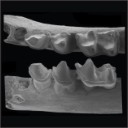
An evening bat (Chiroptera: Vespertilionidae) from the late Early Eocene of France, with comments on the antiquity of modern bats
Published online: 01/08/2016
Keywords:
evolution; palaeobiogeography; Prémontré; Western Europe; Ypresian
https://doi.org/10.18563/pv.40.2.e2
Abstract
Bats are among the most numerous and widespread mammals today, but their fossil record is comparatively meagre and their early evolution poorly understood. Here we describe a new fossil bat from dental remains recovered from late Early Eocene sediments at Prémontré, northern France. This 50 million-year-old bat exhibits a mosaic of plesiomorphic and apomorphic dental features, including the presence of three lower premolars, a single-rooted p3, short p4 with metaconid, myotodont lower molars and a tall coronoid process of the dentary. This combination of features suggests it is an early member of Vespertilionidae, today’s most speciose and geographically widespread bat family. The Prémontré bat has bearing on hypotheses about the origins of vesper or evening bats (Family Vespertilionidae), as well as crown-group chiropterans.
PV article infos
Published in Vol.40-2 (2016)
|
PDF
|

|
Contributions à l'étude du gisement Miocène supérieur de Montredon (Hérault). Les grands mammifères. 4 - Les artiodactyles Suidae.
Published online: 15/11/1988
Keywords:
Artiodactyla; France; Mammalia; Montredon; Upper Miocene
https://doi.org/10.18563/pv.18.ext.57-64
Abstract
There is only one suid known in the Upper Miocene of Montredon (Hérault): Microstonyx (Limnostonyx nov. subgen.) antiquus (KAUP). It is differenciated from Microstonyx major by the presence of upper and lower canines which are considerably longer and biger. Its presence at Montredon corroborates the palustrine habitat for the species.
PV article infos
Published in Vol. 18, Ext (1988)
|
PDF
|
|
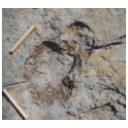
Small sauropod tracks in the Hettangian of Southern France – A case of ichnite fossilization in an intertidal zone
Published online: 28/06/2022
Keywords:
Intertidal zone; Lower Jurassic; Sauropods; Southern France; Tracks
https://doi.org/10.18563/pv.45.2.e1
Abstract
This paper presents the description and the interpretation of recently discovered traces on a Lower Hettangian dolomitic outcrop in the Bédarieux area, Southern France. One trace set immediately attracted the attention by its resemblance to a small sauropod pes-manus couple but no trackway was visible. As the other traces have a variety of shapes with no obvious significance, it took a thorough examination of the 3D and sedimentological data to come to the conclusion that most traces likely were sauropod tracks made under diverse conditions. Sedimentological and ichnological data indicate that the tracks have been made in the intertidal zone of a carbonated tidal flat shortly before an emersion period. It appears that that the variety of trace shapes is due to a variety of water depths: the sauropods were punting when the water level was high. The lack of trackways seems due to the combination of an underprint situation, buoyancy effects and the small size of the track-bearing slab. Several hypotheses can be considered for explaining the very small size of the tracks, such as insular dwarfism or the immaturity of the trackmakers.
PV article infos
Published in 45-2 (2022)
|
PDF
|
|
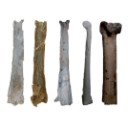
The geologically youngest remains of an ornithocheirid pterosaur from the late Cenomanian (Late Cretaceous) of northeastern Mexico with implications on the paleogeography and extinction of Late Cretaceous ornithocheirids
Published online: 21/07/2020
Keywords:
Coahuila; Late Cenomanian; north-eastern Mexico; Ornithocheiridae; Pterosauria
https://doi.org/10.18563/pv.43.1.e4
Abstract
Ornithocheirid pterosaurs were the largest of the toothed pterodactyloids and had a worldwide distribution, although their fossil record is fragmentary, with the exception of the north-eastern Brazilian Crato and Santana Formations (Aptian, ?Albian, Early Cretaceous). With Istiodactylidae, they were also the only toothed pterosaurs that survived into the Cenomanian (Late Cretaceous), becoming extinct at the end of this period. Here we report on an ornithocheirid metacapus from the Late Cenomanian laminated limestone of north-eastern Mexico discovered about 120 km north-west of Ciudad Acuña, northern Coahuila at the south banks of Rio Bravo. The specimen comprises a fragmentary distal syncarpal, a crushed but complete metacarpal IV, two fragmentary preaxial metacarpals and a possible fragmentary terminal left wing finger phalanx. It represents the geologically youngest known ornithocheirid worldwide. We suggest that ornithocheirid pterosaurs may have become extinct because of massive sea level fluctuations during the mid to late Cretaceous that may have obliterated their breeding sites on coastal plains and low lying islands.
PV article infos
Published in Vol 43-1 (2020)
|
PDF
|
|
Revision of the historical collections of Pliocene-Pleistocene large mammals from Le Riège and Saint-Palais localities, near Pézenas (Southern France)
Published online: 23/06/2025
Keywords:
Hérault; Mammalia; Montpellier; Neogene; Quaternary
https://doi.org/10.18563/pv.48.1.e2
Abstract
Numerous “Quaternary” large-mammal fossils have been collected since the 1830s along the Le Riège stream, near Pézenas (Southern France). More than 120 specimens are stored in the collections of the Université de Montpellier (UM) under the name “Le Riège”. A major operation aiming at relocating the palaeontological collections of the University has made it possible to group together all the specimens of interest and launch their systematic revision for the first time. The fossils belong to the Reboul (1839; 51 samples) and de Christol (1865; 18 samples) Collections and 17 samples compose the Crochet & Ivorra Collection (1998). The remaining 38 samples have no mention about the exact time and location of their finding. We provide a critical inventory with literal transcription of inscriptions on specimens and historical labels. This revision confirms the presence of two distinct faunal assemblages under the name of “Le Riège”: Saint-Palais (Early Pliocene, MN14–15) and Le Riège sensu stricto (late Early Pleistocene, most likely MNQ19). The former assemblage, with coastal affinities, is composed of the ruminants Alephis sp. and Procapreolus cf. pyrenaicus, the rhinocerotid Pliorhinus megarhinus, the gomphotheriid Anancus arvernensis and marine mammals, all emblematic taxa for the Early Pliocene of Montpellier and Perpignan. The latter assemblage documents a late Early Pleistocene fluvio-volcanic sequence, yielding the bovid Bison (Eobison) spp., the cervid Eucladoceros cf. giulii, the hippopotamid Hippopotamus antiquus, the rhinocerotid Stephanorhinus etruscus, the equid Equus cf. altidens, and the elephantid Mammuthus cf. meridionalis, plus a few specimens of uncertain taxonomic affinities. This revision underscores the interest of revisiting historical collections and further provides a starting point for future research.
PV article infos
Published in 48-1 (2025)
|
PDF
S.I. Data
|
|
The beginning of the adaptive radiation of Theridomorpha (Rodentia) in Western Europe: morphological and phylogenetic analyses of early and middle Eocene taxa; implications for systematics
Published online: 20/09/2021
Keywords:
characters analyses; Dental morphology; Eocene; Rodentia; variability
https://doi.org/10.18563/pv.44.2.e2
Abstract
This paper provides a revision of the early and middle Eocene European rodents previously referred to as Ischyromyoidea, including taxa considered to be at the origin of the Theridomorpha. The use of an accurate dental terminology and a better understanding of the size and shape of their infra-orbital foramen (i.o.f.) led us to a substantial revision of this group, which allowed to better characterize them and to appreciate their variability. On these bases, phylogenetic analyses (cladistic and standard Bayesian
approaches) of early Ypresian to late Priabonian European rodent species were undertaken in order to highlight the root of the early Theridomorpha and its content. In this paper, the phylogeny was established based on 343 characters (338 dental) through 45 early Paleogene taxa using both cladistic and bayesian analyses. The ingroup included on one hand a few North American genera (Reithroparamys, Microparamys, and Acritoparamys) and European ones (Eogliravus, Ailuravus, Corbarimys, Meldimys, Euromys, Plesiarctomys, and Pseudoparamys) considered until now as being related with the North American superfamily Ischyromyoidea. On the other hand, it included genera close to the root of the Theridomorpha (Sparnacomys, Pantrogna, and Hartenbergeromys) and early Theridomyoidea (Masillamys, Protadelomys, and some Pseudosciuridae). The phylogenetic results obtained via the two
distinct reconstruction approaches are consistent in virtually all relationships. The proposed systematics here derives from these phylogenetic results. This phylogenetic context led us to change the suprafamilial, familial, subfamilial or generic attribution of several species. Characters of Theridomorpha, like the obliquely developed postprotocristid allied with the occurrence of a metalophulid I, have been found in genera previously considered as Ischyromyidae (Pseudoparamys, Euromys, Sparnacomys, Meldimys, Pantrogna, and Hartenbergeromys) as well as the large i.o.f., when preserved (Pseudoparamys, Hartenbergeromys, and Masillamys). Based on these morphological observations and new phylogenetic considerations, the content of the Theridomorpha clade is here enlarged, thereby extending back the first theridomorph radiations to the early Eocene. Aside, a new taxon (Reinomys rhomboides gen and sp. nov.) is described from Avenay. In addition, a new genus, Auroremys, is created for the species subita (Comte et al., 2012) from Chery-Chartreuve.
PV article infos
Published in 44-2 (2021)
|
PDF
S.I. Data
|
|
New Late Miocene plecotine bats (Chiroptera, Vespertilionidae: Plecotini) from Gritsev, Ukraine
Published online: 07/03/2019
Keywords:
Barbastella; bats; late Neogene; Mammalia; Plecotus
https://doi.org/10.18563/pv.42.1.e2
Abstract
The Late Miocene site of Gritsev (MN 9, Ukraine) has yielded a very rich bat fauna, the remains of which are well preserved. Compared to other Neogene bat assemblages of Europe, the Gritsev bat community is unique in preserving plecotine bats, which are rare from Neogene sites. Some peculiar and new bat species, including a large plecotin Otonycteris, already were described from the Gritsev mammal site. Here we report new records of small plecotin bats from Gritsev, including a new taxon, Barbastella maxima nov. sp. This is the earliest reliable fossil record of this genus and it differs from more recent species of Barbastella in being considerably larger. The evolutionary patterns in the odontology within the tribe Plecotini, supported by biostratigraphical distribution of fossil records of Plecotus are discussed. The morphological peculiarities of the new fossils of plecotine bats from Gritsev are discussed in connection with its possible taxonomical affinity.
PV article infos
Published in Vol 42-1 (2019)
|
PDF
|

|
Les Bovidae (Artiodactyla, Mammalia) du Miocène moyen de la formation Hofuf (Province du Hasa, Arabie Saoudite).
Published online: 30/12/1983
Keywords:
Biostratigraphy; Bovidae; Middle Miocene; Palaeogeography; Saudi Arabia
https://doi.org/10.18563/pv.13.5.157-206
Abstract
The study of the bovids from Al Jadidah (Hofuf Formation, Saudi Arabia) confirms that the fauna comes from a pre-Hipparion level. The Al Jadidah age is close to that of Fort Ternan (14 m.y.) and Beni Mellal, but cannot be older than that of Fort Ternan. The age of the Hofuf Formation is close to but slightly older than the oldest deposits of the Ngorora Formation (Kenya). 7 to 9 species have been recorded, of which 2 to 4 remain indeterminate. If the great specific diversity of te bovids from this locality gives evidence of immigrations from anterior Asia (Turkey) (e.g. Pachytragus Iigabuei sp. nov.), the bovid assemblage of Al Jadidah results in fact from a double influence: from the anterior Asia and mainly from Africa (e.g. the Caprotragoides lineage and the Neotragini? Homoiodorcas). The Al Jadidah bovids reflect, on the whole, the predominant character of open to very open environment, which supports the conclusions drawn from our two preliminary studies.
PV article infos
Published in Vol. 13, Fasc. 5 (1983)
|
PDF
|

|
Book of Abstracts of the 20th Annual Conference of the European Association of Vertebrate Palaeontologists, 26th June – 1st July 2023, Sabadell (Barcelona), Spain
Published online: 15/06/2023
Keywords:
Abstracts; EAVP
https://doi.org/10.18563/pv.eavp2023
Abstract
PV article infos
Published in special issue 1-2023 (2023)
|
PDF
|
|
A new species of bat (Chiroptera: Vespertilionidae) from the early Oligocene global cooling period, Brule Formation, North Dakota, USA
Published online: 09/12/2019
Keywords:
Eocene-Oligocene global cooling; Mammalia; Oligocene; Plecotini; Quinetia
https://doi.org/10.18563/pv.42.2.e2
Abstract
We report the first confirmed fossil bats from North Dakota, including a new species referable to the Vespertilionidae represented by a maxilla with P4-M3 from the Brule Formation, Fitterer Ranch local fauna, early Oligocene, Whitneyan North American Land Mammal Age. Unassociated postcranial fragments of the humerus and femur also represent a vespertilionoid, but appear to reflect a different, unidentified species. The new taxon, Quinetia frigidaria sp. nov., is referred to the genus Quinetia, previously known only from approximately contemporaneous deposits in Europe. The new species is larger than Quinetia misonnei from the early Oligocene of Belgium. It is similar in some morphological characters to Chadronycteris rabenae (Chiroptera incertae sedis) of the late Eocene (Chadronian) of northwestern Nebraska and to Stehlinia species (?Palaeochiropterygidae) from the Eocene and Oligocene of Europe, but differs from each in morphological details of the dentition and maxilla. An unassociated talonid of a lower molar from Fitterer Ranch shows myotodont morphology, unlike the nyctalodont lower molars in Q. misonnei, and thus represents a second chiropteran taxon in the fauna. Quinetia frigidaria is a member of a Paleogene radiation of bats near the low point of the Eocene-early Oligocene decline in global temperatures, increased seasonal aridity, and loss of tropical floras from mid-latitude North America.
PV article infos
Published in Vol 42-2 (2019)
|
PDF
|

|
La plus ancienne faune de mammifères du Quercy : Le Bretou
Published online: 01/12/1974
Keywords:
Le Bretou; Quercy Phosphorites
https://doi.org/10.18563/pv.6.3-4.177-196
Abstract
Redécouvertes en 1968 dans le bois du Bretou, les deux poches à phosphorites qui ont livré cette faune sont parmi les plus méridionales du plateau quercynois. De faible profondeur, huit mètres, les cavités sont de petite taille et font partie d'un complexe de sept fissures réparties dans les bois du Bretou. Les autres trous n'ont livré aucun fossile, soit parce qu'ils avaient été intégralement vidés de leur sédiment, soit que des venues d'eau en interdisent l'accès.
Dans les deux poches fossilifères, proches de quelques mètres, le sédiment que l'on rencontre en placage sur les parois présente un aspect particulier. Il s'agit en effet d'une brèche très indurée, où la calcite domine, et contenant assez peu de sédiments sidérolithiques. Les ossements contenus dans cette brèche sont assez nombreux, très souvent brisés. Les dents isolées y sont relativement rares. Exploitées séparément, les deux poches ont livré des faunes identiques, aucune différence chronologique ne pouvant être décelée entre elles. Les formes rencontrées dans une seule des cavités sont rares mais la poche la plus riche est celle dénommée Le Bretou 2.
L'intérêt de la faune récoltée réside dans son ancienneté. On sait en effet que H.G. Stehlin avait signalé dans les collections du Quercy des restes attribuables à Lophiodon lautricense, mais la provenance exacte de ces fossiles reste inconnue. Au Bretou si nous n'avons pas rencontré à ce jour le Lophiodon, il n'en demeure pas moins que l'âge de la faune récoltée doit être proche de celui de la faune de Robiac.
PV article infos
Published in Vol. 06, Fasc. 3-4 (1975)
|
PDF
|

|
Fossil snakes from the Palaeocene of Sao José de Itaborai, Brazil, Part II. Boidae
Published online: 28/12/2001
Keywords:
Boidae; Boinae; Brazil; Erycinae; New taxa; Palaeocene; Snakes
https://doi.org/10.18563/pv.30.3-4.111.150
Abstract
The middle Palaeocene of São José de ltaboraí (State of Rio de Janeiro, Brazil) has produced a rich and diverse fauna of boid snakes. It comprises six or seven species: Hechtophis austrinus gen. et sp. nov., Corallus priscus sp. nov., Waincophís pressulus sp. nov., Waincophis cameratus sp. nov.,"Boinae A", and "Boinae B". Moreover, two dentaries might pertain to either H. austrinus or "Boinae B", or even represent a distinct taxon. Hechtophis austrinus is assigned, with reservation, to the Erycinae. All other taxa are referred to the Boinae. The vertebrae of all taxa have paracotylar foramina, which raises the problem of the apomorphic or plesiomorphic nature of this feature. This fauna also raises the question of the presence of extinct erycine boids in South America, but it does not allow this question to be settled.
PV article infos
Published in Vol. 30, Fasc. 3-4 (2001)
|
PDF
|
|
Rodent paleocommunities from the Oligocene of Ulantatal (Inner Mongolia, China)
Published online: 10/06/2014
Keywords:
late Paleogene; Mammalia; Mongolian Plateau; Rodentia; Systematics
https://doi.org/10.18563/pv.38.1.e3
Abstract
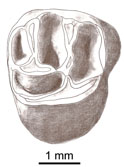
The Oligocene deposits of the Ulantatal area in Inner Mongolia (China) contain among the richest mammalian faunas from Asia. To date, only some parts of the rodent faunas have been described. Here, we propose to review the rodent faunal lists for each site, including the description of a few new rodent specimens. We describe three additional rodent species: the Cylindrodontidae Anomoemys lohiculus, the Eomyidae Asianeomys sp., and the Dipodidae Litodonomys huangheensis. This study allows us to constrain the stratigraphic range of Anomoemys lohiculus, which ranged from the late Early Oligocene to the early Late Oligocene in this area. Asianeomys sp. and Litodonomys huangheensis are dated from the latest Oligocene. These Oligocene deposits consist now of more than 70 species of mammals if we include the fauna from Kekeamu. This latter corresponds to the basal part of the Ulantatal Formation and could be dated biochronologically from the earliest Oligocene. When compared to the faunas from the Valley of Lakes in Central Mongolia, the Ulantatal faunas present a great majority of rodents, and this difference can be partly explained by sampling and description biases regarding macro-mammals. This study also shows that variations existed between Inner and Central Mongolia, especially regarding the composition of the rodent paleocommunities. However, the assessment of their evolutionary history in this part of Asia with respect to the important climate and environment changes, require further precisions and more material than current data allow.
PV article infos
Published in Vol.38-1 (2014)
|
PDF
|
|
Two new scyliorhinid shark species (Elasmobranchii, Carcharhiniformes, Scyliorhinidae), from the Sülstorf Beds (Chattian, Late Oligocene) of the southeastern North Sea Basin, northern Germany.
Published online: 30/04/2014
Keywords:
Chattian; Elasmobranchii; North Sea Basin; Scyliorhinidae; Scyliorhinus
https://doi.org/10.18563/pv.38.1.e1
Abstract
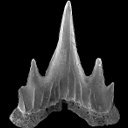
Based on isolated teeth two new scyliorhinid shark species, Scyliorhinus biformis nov. sp. and Scyliorhinus suelstorfensis nov. sp., are described from the Sülstorf Beds, early-middle Chattian, of Mecklenburg, northeastern Germany. They form part of a speciose assemblage of necto-benthic sharks and batoids which populated the warm-temperate to subtropical upper shelf sea of the south-eastern North Sea Basin.
PV article infos
Published in Vol.38-1 (2014)
|
PDF
|

|
The Ctenodactylidae (Rodentia) from the Oligocene of Ulantatal (inner Mongolia, China)
Published online: 15/12/2006
Keywords:
Adaptive radiation; Ctenodactylidae; Mongolia; Oligocene; Rodents
https://doi.org/10.18563/pv.34.e11
Abstract
This paper proposes a systematic revision of the Oligocene Mongolian Ctenodactylidae, on the basis of abundant material obtained by screen/washing operations in stratified localities of the Ulantatal area (Inner Mongolia) (UTL1, 2, 3, 4, 5, 7, 6 & 8). A Chinese-German team has collected several thousands of isolated rodent teeth, and a number of fragmentary jaws. A new genus is identified (Alashania nov. gen. tengkoliensis nov. sp.), and eight former species are reevaluated, Karakoromys decessus, Tataromys sigmodon, T. minor, T. plicidens, Yindirtemys ulantatalensis, Y. bohlini, Y. deflexus, with several synonymies. A new Yindirtemys species is described: Y. shevyrevae nov. sp. and another one close to that: Y. aff. shevyrevae nov. sp. Four new species, which are rare in the localities, remain in open nomenclature because they are not well-represented. Yindirtemys differs from the other genera by the permanence of crescentic structures, while the other genera show a general reduction of the trigonoid area (= anterior valley). We define a range of size variation for each well documented population. Although the dental morphology shows a wide range of variation, given that transitional morphologies occur in a single locality, it is possible to provide a clear definition for most species. We show that dental patterns of the different genera can be derived from the pattern of Karakoromys. As a number of Tataromyinae have been determined in several localities from China, Kazakhstan and Mongolia, usually on the basis of scarce material, or surface collections, the present study would be used to re-evaluate their attribution inasmuch as the taxa are now placed in the Oligocene stratigraphy. The diversity of sizes and forms reflects the adaptive radiation of the family during the Oligocene, within a forested environment where the vegetation was probably abundant.
PV article infos
Published in Vol. 34, Fasc. 3-4 (2006)
|
PDF
|
|
Morphological description and identification of an extraordinary new elephant cranium from the early Pliocene of Ileret, Kenya
Published online: 21/10/2021
Keywords:
Elephantidae; Loxodonta adaurora; cranium; early Pliocene; Ileret; Kenya
https://doi.org/10.18563/pv.44.2.e3
Abstract
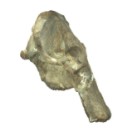
Abstract: Paleontological exploration in the Turkana Basin near Ileret, Kenya yielded the most complete adult elephant cranium (KNM-ER 63642) known from the late Miocene to mid-Pliocene. KNM-ER 63642 derives from the lower Lonyumun Mb. of the Koobi Fora Fm. and dates to the early Pliocene, >4.3 Ma. The cranium is immense in size and preserves most of its structures including left and right M2-3, permitting its comprehensive comparative study and secure taxonomic assignment to Loxodonta adaurora. Features distinctive of the species and exhibited by KNM-ER 63642 include very elongate, divergent tusk alveoli, a short, biconvex cranial roof, anterosuperior angulation of the occipital planum, non-inflated occipital planum and absence of supralateral parietal "bossing," broad, flat premaxillary nasal processes, broad, laterally downturned nasal aperture superior to the level of the orbits, and M3s with wide, subhypsodont plates that are parallel-faced and separated by U-shaped transverse valleys. The M3s also exhibit characteristic L. adaurora traits of greatest width at their bases, rounded cross-sectional shape, thick enamel, abundant cementum, and strong anterior and posterior accessory conules. Of extant taxa, KNM-ER 63642 most closely resembles crania of African elephants. Its inclusion in the Loxodonta clade is tenuous, however, because shared features are either symplesiomorphic or are difficult to test for synapomorphy due to the poor fossil record of crania of late Miocene-early Pliocene elephants. Overall, the cranial morphology of KNM-ER 63642 is unexpectedly advanced for an elephant of its antiquity. Its anteroposterior compression and height are concordant with efficient proal masticatory action, indicating that by the early Pliocene L. adaurora evolved craniodental adaptations in phase with feeding preference for C4 grasses. The advantage of synchrony of morphology and behavior is reflected by the dominance of the species in the greater Turkana Basin during that interval.
PV article infos
Published in 44-2 (2021)
|
PDF
|

|
A New caseid Synapsid from the Permian (Guadalupian) of the Lodève basin (Occitanie, France)
Published online: 18/07/2022
Keywords:
; Caseidae; France; Guadalupian; semi-aquatic lifestyle
https://doi.org/10.18563/pv.45.2.e2
Abstract
Lalieudorhynchus gandi gen. nov. and sp. nov. is a new caseid synapsid from the Permian of the Lodève Basin, Occitanie, France. This new taxon is represented by a partial but well-preserved postcranial skeleton, and is characterized by the following apomorphies: a transverse section of the sacral and anterior caudal neural spines with a very thin keel-like process anteriorly, a slender dorsal tip of the dorsal and caudal spines, a narrow distal end of the first sacral rib, a fossa on triceps process of metacoracoid, and a very large distal tarsal 1 of same width than the astragalus, with nearly all sides being shallowly concave.
The skeleton corresponds to a sub-adult individual that was excavated from the La Lieude Formation dated as Roadian-Capitanian (Guadalupian). A sedimentological and taphonomical analysis of the type locality, together with preliminary osteohistological observations, suggest that this new French caseid was rather aquatic, as already hypothesised for other large forms.
A phylogenetic analysis of caseids is performed to test the position of this new taxon and to better understand the evolution of the clade: interestingly, Lalieudorhynchus gandi gen. nov. et sp. nov. is closer to the NorthAmerican “Cotylorhynchus” hancocki than to the other French caseids Ruthenosaurus and Euromycter from the Artinskian of the geographically closer Rodez Basin. These two last caseids document the Artinskian radiation of the clade, which remained diverse until Olson’s extinction. Caseids survived, as Lalieudorhynchus is one of the youngest representatives of the clade, and may have used novel ecological strategies to access their vegetarian food sources.
PV article infos
Published in 45-2 (2022)
|
PDF
|
|
The skull of Tetraceratops insignis (Synapsida, Sphenacodontia)
Published online: 09/01/2020
Keywords:
cranium; pelycosaur; Permian; therapsid origins
https://doi.org/10.18563/pv.43.1.e1
Abstract
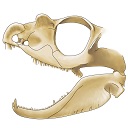
Tetraceratops insignis is known from a single, crushed skull from the Lower Permian of Texas. Its unique proportions and osteological details gained central meaning in the question of the origins of Therapsida since this early synapsid has been determined as the oldest and less derived therapsid. Apart from Tetraceratops, the ‘mammal-like’ Therapsida and their sister, the pelycosaur-grade Sphenacodontidae, are separated by one of the longest ghost lineages in tetrapod fossil record. However, the minor, though well justified critique faced insistent publication regarding the therapsid hypothesis. A carefull re-evaluation of the holotypic skull reveals that therapsid traits cannot be supported, including a rejection of the formerly supposed adductor shelf in the temporal fenestra. Increased understanding of ‘pelycosaur’ character variation underlines a haptodontine-grade or, less likely, sphenacodontid position for Tetraceratops.
PV article infos
Published in Vol 43-1 (2020)
|
PDF
|

|
Macroscelidea, Insectivora and Chiroptera from the Miocene of east Africa.
Published online: 15/11/1984
Keywords:
Chiroptera; East Africa; Insectivora; Macroscelidea; Miocene; Systematics
https://doi.org/10.18563/pv.14.3.117-198
Abstract
The East African Miocene Macroscelidea, lnsectivora and Chiroptera are revised on the basis of new material. New taxa proposed are: Miorhynchocyon, .n. gen. (Macroscelididae): Míorhynchocyon meswae, n. sp.: Pronasílío ternanensis. n. gen.. n. sp. (Macroscelididae); Hiwegicyon juvenalis, n. gen. n. sp. (Macroscelididae); Parageogale, n. gen. (Tenrecidae): Prochrysochlorinae, n. subfam. (Chrysochloridae): Propottininae, n. subfam, (Pteropodidae); Chamtwaria pickfordi, n. gen., n. sp. (Vespertilionidae). Gymnurechnínus songhorensis is synonymised with G. camptolophus. The new material provides additional information on the dentition, especially of Myohyrax oswaldi. Galerix africanus. Amphechínus rusingensis, Protenrec tricuspis and Parageogale aletris. Partial skulls are described of Amphechinus rusingensis, Protenrec tricuspis, Prochrysochloris míocaenicus and Taphozous incognita. The oldest member of the Macroscelidinae (Pronasilio) is described from Fort Ternan. Galerix africanus is closely related to G. exilis from Europe. Amphechinus rusingenesis is compared with Asiatic Oligocene Erinaceinae. The Miocene age of Crocidura is rejected. On the evidence of humeri, the following families of Chiroptera are newly reported: Pteropodidae, Nycterididae, Vespertilionidae, Molossidae. Propotto is regarded as an offshoot from the Pteropodidae, not ancestral to modern forms. Chamtwaria is a primitive vespertilionoid, provisionally placed in the Kerivoulinae. Erinaceidae probably entered Africa at the beginning of the Miocene, before 20 Ma. Faunistic differences between deposits are largely to be ascribed to differences in local environment.
PV article infos
Published in Vol. 14, Fasc. 3 (1984)
|
PDF
|